Tuesday, January 31, 2012

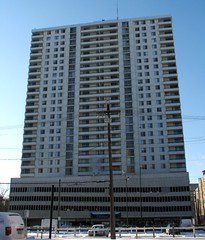
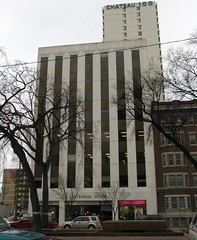
72 Donald Street - Chateau 100

Chateau 100

Place: Chateau 100 (Website)
Location: 72 Donald Street (Map)
Opened: Fall 1970
Developer:
M.E.P.C. Canadian Properties Limited

Contractor:
InterOcean Contracting
Cost:
$5.3 m (total project cost, including Centennial House)


Background
:

Illustration, March 14 1969, Winnipeg Free Press.

Despite their distinct appearances, Chateau 100 and Centennial House were constructed as one complex.
The names of both buildings reference the Manitoba Centennial year of 1970.

The project was first proposed in 1964. The land was purchased and existing properties, mostly old apartment blocks, were demolished. MEPC Canadian Properties, however, got into a dispute with the province and city over the high cost of property taxes in the downtown so they put a moratorium on new projects in the city.
MEPC Group was a national real estate development and management company that had a number of holdings in Winnipeg.

A 1969 tax freeze on new construction in the downtown brought MEPC back to the table. On March 14, 1969 Mayor Juba and Premier Weir stood together with MEPC president Peter Anker as the $5.3 project was announced at the Charter House Hotel.


Winnipeg Tribune, December 1969 (source)

Construction began in 1969. Centennial House, the 8-storey office portion facing Broadway, was the first to open on July 1, 1970.

Display suites for the 26-storey Chateau 100 opened in July 1970 and and tenants began moving in during the winter months. Bachelors rented for $132.50 per month, 1-bedrooms at $149.50 and 2-bedrooms at $189.50.

It appears that there was no formal grand opening.

May 22, 1971, Winnipeg Free Press

Chateau100 has main floor retail space, (original retail tenants included Speedee Mart, a Salisbury House restaurant, barber shop, hairdresser and dry cleaner.) The plaza level has two squash courts, an outdoor sun deck, saunas and a gym. The upper floors contain six floors of covered parking and 260 bachelor, one and two bedroom apartments.

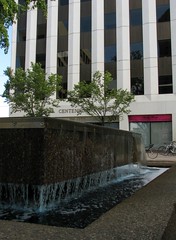
'Shoal Lake Anniversary' Fountain

MEPC also was responsible for covering a majority of the costs of
Centennial Fountain located on the boulevard on Broadway across from Centennial House as part of the project.

Tuesday, January 17, 2012

464 St. Mary - Mall Plaza & Abbott Clinic / Sussex Realty Building

Mall Plaza / Abbott Clinic
Place: Mall Plaza & Abbott Clinic / Sussex Realty Building
Address: 464 St Mary Ave. / 274 Osborne St. N. (Map)
Cost: $100,000
Architect: J. H. G. Russell
Contractor: W. A. Cameron
Opened: December 30, 1927


David Cooper
came to Canada from Forfar, Scotland in 1907 with less than $5 to his name. An accountant by trade, he took a job with the accounting firm D. A. Pender in 1909 and tutored accounting students on the side. Within a couple of years tutoring became his main business and the Cooper Institute of Accountancy was launched. Months later, the Dominion Business College sprang from the institute with his old boss Mr. Pender as president.


Left ca. 1926. Right ca. 1928

The institute and college began in the Carlton Building then moved to the New Enderton Building at Portage and Hargrave (next to Eaton’s.) In July 1927 they decided to build a building of their own and spent $25,000 to buy a cluster of homes at what had recently become one of the most prominent addresses in the city.

“The Mall” (now Memorial Boulevard) was created just a couple of years earlier, the result of a number of land swaps between the city, province and Hudson’s Bay Company. It allowed the Bay enough land to construct a new downtown department store (1926) and gave the city enough land on which to build an auditorium (1932). The land north of St. Mary was occupied by the U of M but moved to the Fort Garry campus in the following decades.


December 28, 1927, Winnipeg Free Press

The institute portion of the building was opened on Friday, December 30, 1927 by the provincial minister of education.

The comfort of students was top of mind. There was an air scrubber system, normally reserved for places like theatres, to ensure that fresh air was always circulating. The large windows ensured the maximum amount of natural light. There was a cafeteria in the basement that doubled as meeing space for service clubs, social events and speakers.

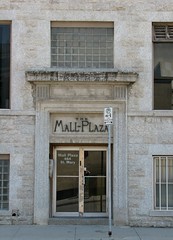
Mall-Plaza Building

The Tyndall stone facade and detailed stonework around the entrance were chosen so that the building would not look out of place among the existing buildings and those proposed for the boulevard.


There was also a branch of the school at 201 Hespeler (opened 1927) as well as a Manitoba Business College at Portage and Langside. Soon, another branch opened in St. James.

Mall-Plaza Building
February 29, 1928, Winnipeg Free Press

The residential suites of the Mall Plaza opened in February 1928. The 22 suites boasted a number of modern conveniences such as electric lights, ovens and fireplaces in every suite. Murphy Beds were used to maximize floor space. Each suite had a unique floor plan to make the best use of natural light.

In 1947 the institute downsized. Gone was the Elmwood branch and the Memorial Boulevard headquarters was sold off. Operations were centralized at the St. James location which closed in 1951.

Mall-Plaza Building

June 26, 1947, Winnipeg Free Press

In May 1947 the Abbott Clinic bought the building.


The Abbott Clinic was created in the early 1930s by two brothers, Drs. Fred and Clifford Abbott, who worked out of the fourth floor of the Power Building. They converted the institute portion of the building into medical offices. Labs and an X-ray department were set up in the basement. The apartments remained on the upper floors.

In February 2006 Dr. Bill Abbott, son of Fred, announced that the building had been sold and the clinic would close. The management company representing the owner was Sussex Realty.

Mall Plaza / Abbott Clinic
Ca. 1978 ad

In late 2011 the building was rechristened the Sussex Realty Building. The company, formed in 1978 at 427 Academy Road, will relocate there in February 2012.


Source: Metro

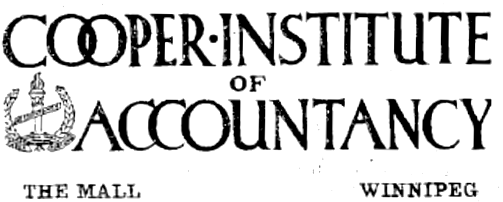
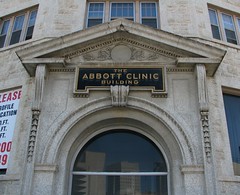
While renovating the building, the Abbott Clinic's bronze sign over the front entrance was removed to reveal the remnants of the original Cooper Institute sign !

Monday, January 9, 2012

235 Notre Dame Ave - St. Charles Hotel

St. Charles Hotel
Place: The St. Charles Hotel
Address: 235 Notre Dame Avenue (Map)
Opened: August 1, 1913
Architect: Carter, Halls and Aldinger
Cost: $122,000

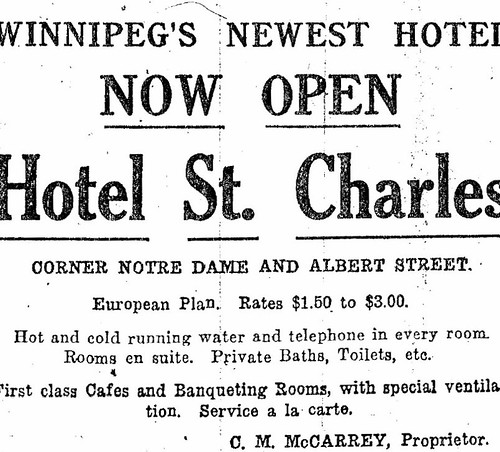
Notre Dame and Albert, 1912 and 1913 November 29, 1913, Manitoba Free Press

Despite being a stone's throw from Portage and Main, the corner of Notre Dame and Albert didn't see much spillover from the frantic pace of downtown development that took place in the early 1900s.

In 1912, the corner still consisted of aging, single-storey, wooden structures.

That changed in 1913 with the St. Charles, Lindsay Building, Electric Railway Chambers and Royal Albert Arms Hotel all opening within months of each other.


St. Charles Hotel Opening
July 30, 1913, Manitoba Free Press

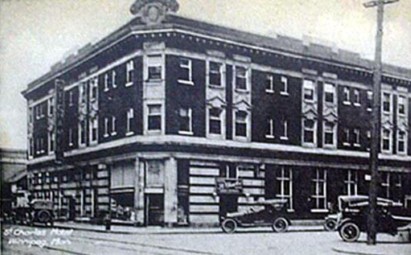
The St. Charles Hotel was built in 1913 for well-known hotelier Charles (Charley) M. McCarrey, the owner of the St. Regis and Inter Ocean Hotel.

The hotel's official opening took place on August 1, 1913, but was rushed into service a few days before that.


On July 28 - 30, 1913, the city hosted what many considered its most important conference to-date: the National Association of Real Estate Exchanges, which brought together officials and developers from across North America. The two largest delegations were from Minneapolis and Chicago and the St. Charles was slated to house 150 of them.

Carter Halls Aldinger Co., who acted as both the architects and the builders, had crews working through the night to get the hotel ready in time to meet the deadline.
Less than a year later, October 1, 1914, another prominent hotelier, George Skinner, took possession of the St. Charles.


October 15, 1914, Winnipeg Free Press

While McCarrey seemed to concentrate more on being a quality hotel, the British-raised Skinner had a flair for the entertainment side of things. He told the Tribune in 1928:


"Winnipeg should take advantage of is position to develop this cosmopolitan character as one of its choicest assets. Along with this, I hope to see a keener appreciation for the lighter side of life - for mental and physical recreation in a good play and the theatre party that follows."

Using the tagline "In the Heart of Everything", he turned the hotel's restaurant into a source of late night entertainment, featuring its own orchestra.

Due to the hours and its location, the St. Charles was said to be the hotel of choice for performers at the nearby Orphium Theatre, where acts like Milton Berle, the Marx Brothers once performed. (Today, most old theatres boast of hosting top acts but the Orpheum was the one that actually delivered, thanks to being part of Keith Orpheum's entertainment empire, which included RKO Radio and RKO pictures.)

The entertainment attracted performers from other theatres after their shows and the evenings became an attraction in themselves.

During World War I, the Friday night soirees were often turned into fundraisers for groups like the Red Cross and Kiwanis Club. Acts would drop in to perform number or two to help the cause.


Empire Grill at the St. Charles (source)

In 1928, Skinner extensively renovated the hotel's basement into the Tudor-inspired Empire Grill, based on the luxurious dining rooms seen in European hotels.The restaurant, and later the conference rooms, the Rose Room and Blue Room, were the scene of thousands of banquets, social club meetings and wedding receptions receptions well into the 1950s.


December 7, 1963, Winnipeg Free Press


At some point in the late 1920s or early 1930s the owner of the hotel became the St. Charles Hotel Company, the majority shareholder being J. J. Gray. He was also the proprietor of the McLaren Hotel and the Kenricia in Kenora.

In 1947, the hotel was sold to
Rothstein Investments, controlled by the Rothstein family.

In late 1963, the 60-room hotel was purchased by Donald Stefanyk, whose family had run the Empire Hotel. They modernized the place into what was expected of a 1960s downtown hotel.


ca. 1965 ad

Gone was the Empire Grill in favour of a lounge called Big Al's Gas House. The Kodiak Beverage Room was added. The coffee shop and a banquet room remained.


July 20, 1967, Winnipeg Free Press

In 1967, a new owner took over.

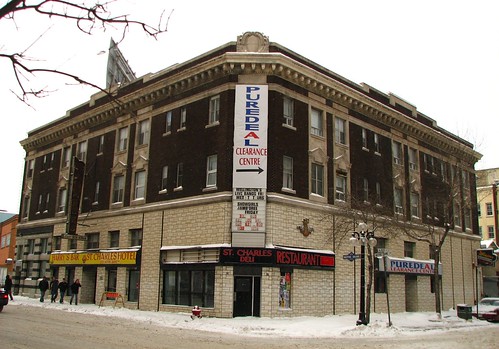
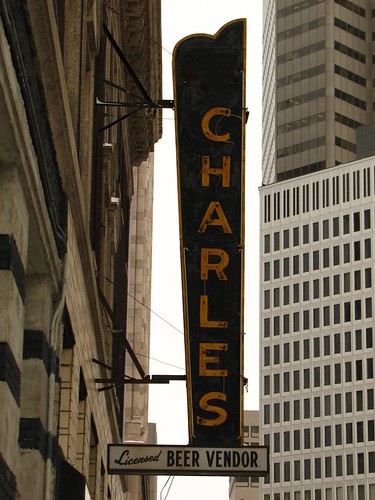
Harry Katz continued the renovations which included adding the white stone tile and modern, backlit signage to the facade.


In the early 1970s the basement was renovated to hold a discotheque which by 1976 was called Wellington's. The punk music club closed in 1989 after the death of Harry's son Abe, who ran the club for a number of years. In the mid 1990s the space was briefly The Crypt.

From 1984 to 1990 the Hotel was re-branded The Market Inn.

November 13, 2004, Winnipeg Free Press

Around the year 2000 Harry Katz was gone from the scene.

The St. Charles experienced an increasing amount of crime, fires and the occasional closure due to health violations. These came to a head in 2004 when the hotel, by then without a functioning restaurant or bar, was closed for good citing a list of health and safety concerns.


In 2005, it was purchased by St. Charles Enterprises and the following year a plan was unveiled to renovate it into a boutique hotel. An application was made to tear down the neighbouring Albert Street block in 2006 to provide additional parking but it was rejected. Other applications in 2008 and 2010 were also rejected.

In April 2011 the owner announced that the development plan now included a multi-storey addition to the existing hotel.

St. Charles Hotel, Winnipeg

Since that time, however, plans for the building have stalled.

In January 2012, the owner appeared before the Committee on Downtown Development, Heritage and Riverbank Management Regular Meeting to appeal a Derelict Building Order issued by the City. (He had a previous order in 2010.) The result was a 30 day postponement for him to put together a detailed development plan to prove to the city that work is ongoing.

After a series of delays, in May 2013 the city put in motion a process by which it could take over the derelict building and sell it to new developers or have it demolished.

UPDATE: February 2014: The owner of the hotel is now challenging the city's historic listing of the building with the hopes of having it removed and the building demolished.

Related:
My St. Charles Hotel photo album at Flickr
St. Charles Hotel Heritage Winnipeg
St. Charles Hotel Historic Building Report
Powerpoint Presentation by developer of St. Charles project

More Images:

 St. Charles Hotel
Buildings

Interior photos from July 2013:

St. Charles Hotel, Winnipeg

St. Charles Hotel, Winnipeg

St. Charles Hotel, Winnipeg

Saturday, January 7, 2012

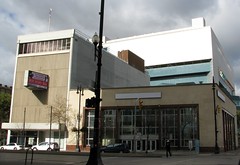
310 Broadway - Centennial House

Chateau 100 / Centennial Building Complex

Place:
Centennial House

Location: 310 Broadway Avenue (Map)
Opened: July 1, 1970
Developer: M.E.P.C. Canadian Properties Limited
Contractor: Bentall Construction
Cost: $5.3 m (total project cost with Chateau 100)

Background


Artist's drawing, March 14 1969, Winnipeg Free Press.

Despite their distinct appearances, Chateau 100 (see next post) and Centennial House were constructed as one complex.
Their names reference the Manitoba Centennial year of 1970.

Construction was to go ahead in 1964.
The MEPC Group, a national real estate development and management company that had a number of holdings in Winnipeg, purchased the land and demolished the existing properties, mostly old apartment blocks. MEPC, however, got into a dispute with the province and city over the high rate of property taxes so they put a moratorium on new projects in the city.

A proposed tax freeze on new construction in the downtown brought MEPC back to the table. On March 14, 1969 Mayor Juba and Premier Weir stood together with MEPC president Peter Anker as the $5.3 project was announced at the Charter House Hotel.


Winnipeg Tribune, December 1969 (source)

Construction began in 1969. Centennial House, the eight storey office portion facing Broadway, was the first to open on July 1 1970. Display suites for the 26 storey Chateau 100 opened the following month and tenants began moving in in the fall.


Initial retail tenants included Mackie Travel. office Boeing of Canada , Xerox, Bentall Construction,
and the Canadian Acceptance Corporation. Current tenants include The Fyxx coffee shop and the Canadian Diabetes Association.

'Shoal Lake Anniversary' Fountain
MEPC also was responsible for covering most of the cost of Centennial Fountain located on the boulevard on Broadway across from Centennial House in 1970.

Monday, January 2, 2012

339 Portage - NEFCO / APTN Building

APTN
Place: NEFCO / APTN Building
Address: 339 Portage Avenue (Map)
Opened: September 7, 1961
Architect: Blankstein, Coop, Gillmor and Hanna
Contractor:
Drake Construction
Cost: $1m (1961).
Size: Seven storeys, 40,000 sq ft .


This building was constructed in 1961 for NEFCO, an acronym for the North End Furniture Company.
The company's roots dated back to a 1932 used furniture store opened by Chaim Adelman at 843 Main Street, (if the address sounds familiar, it later became Kern Hill Furniture Co-op !) The store expanded through the 1950s and by 1958 had branches at Portage and Kennedy, 479 Selkirk Avenue and another on Main Street.

339 Portage Avenue
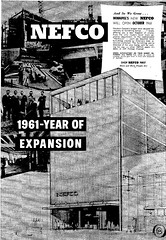
September 1961 ad

In 1960 NEFCO decided to go uptown. The company's expansion plans included this custom-built Portage Avenue store as well as the purchase of the former Campbell Brothers and Wilson Building on Princess Street as the NEFCO Furniture Warehouse. (The Main and Selkirk locations were closed later in the 60s.)


September 6, 1961, Winnipeg Free Press

The store was a big deal at the time given its size and location. Billed as Western Canada's largest furniture showroom with around 30,000 sq feet of sales floor over seven floors. The grand opening took place on September 7, 1961 with Mayor Juba cutting the ribbon.

The m
ost unique feature of the building is the "pre-cast concrete mural" that runs from the second to fifth floor leaving windows on just the ground and top floors.

The entire ground floor was one large display window, full of sample suites and model rooms. The entrance was set far back from the frontage to allow people to browse the suites even after store hours.

The top two floors
was NEFCO's "The Penthouse" which featured "an exclusive collection of home furnishings" and offered design consultants that could tackle a room or an entire home.


In 1966 NEFCO consolidated their sales at the warehouse location, re-branding it Penthouse Interiors. This building was purchased in 1966 by Montreal based Allen Furniture, a retail chain that operated in most of the country except on the prairies. (It may seem odd that they would sell to a competitor but NEFCO was going upscale and Adams was mid-range.)


March 10, 1978, Winnipeg Free Press

By 1976 Adams was gone and the building faced decades of economic uncertainty.

In 1978 former city councillor Al Golden bought the building. It was then renovated into a number of small retail spaces to become a boutique shopping complex called the Northside Centre. Tenants included Pantages Restaurant, a hair salon, fine jewellery store, art shops and a flower shop. A large tenant was Roche Bobois furniture, who took up the old Penthouse Furniture floors.


Two long-term 1980s retailers

In 1981 the building was foreclosed on and in 1983 it had a new owner. Within a year five tenants, including Roche Bobois, moved out. Mr Gold and Pantages remained. In 1985 it was reported that a deal was in the works to sell the building to the Core Area Initiative to expand the newly created Window Park in front of Air Canada Centre. That deal was not finalized and the building was soon foreclosed on again.

In 1989 the building was foreclosed on for a third time and that spelled the end for long term tenants Mr. Gold and Pantages


339 Portage west wall in 1980s (source) and 2011 (source)

In 1990 a Toronto investment company purchased the building and began a $1m upgrade. The interior was gutted and the main entrance was moved to the west wall, which was also opened up to the park with hundreds of windows.

Financial trouble struck yet again and the building was foreclosed on for a fourth and final time. In August 1991 it was put up for sale.

The new owners finished the space as an office building. One major tenant was the
Continuing Education Division of the University of Winnipeg who were there until 1996.


Aug 25 1999 WFP

In 1999 the newly created, Aboriginal People's Television Network leased three floors. Over time, the national network expanded to take up the entire building. In 2010 they purchased this building as well as the neighbouring 333 Portage, which they had previously used as temporary studio space for their coverage of the 2010 Winter Olympics.

At a dozen years, APTN has been the building's longest tenant.

(More on APTN's expansion in a future post !)