Thursday, March 22, 2012

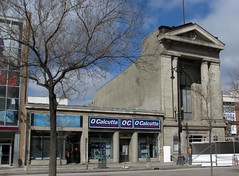
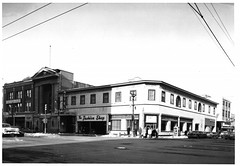
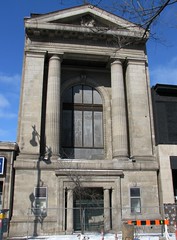
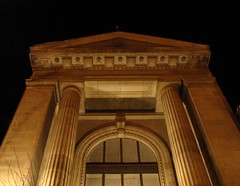
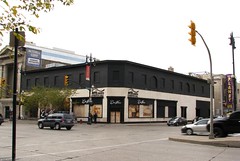
111 Lombard Avenue - Kemp Manufacturing / Brick's Fine Furniture Building

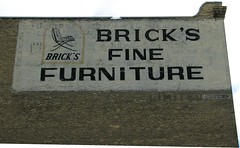
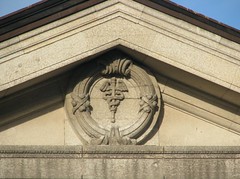
Former Brick's Fine Furniture Building
Place: Kemp Manufacturing / Brick's Fine Furniture Building
L
ocation: 111 Lombard Avenue (Map)
Opened: 1903
Architect:
James Cadham
Contractor:

Size: 6 storeys,
120,000 sq. ft.
Cost: $130,000

Background:

The Kemp Manufacturing Company of Toronto were manufacturers of heaters, stoves, tin boxes, siding and roofing materials. In the late 1890s they entered the Winnipeg market by purchasing a two-storey, 60 x 100 former barbed wire factory on McDermot Avenue East.

May 26, 1906, Winnipeg Free Press

In 1903 the company had architect James Cadham design this three-storey building on Lombard Avenue which combined their offices, warehouse and main floor show room.

A unique feature of the three-storey version was its fire suppression system. A 20,000 gallon water tank on the roof fed an internal sprinkler system. It was a joint experiment with the General Fire Equipment Company of Toronto and the Ontario Wind Engine and Pump Company to see how such a system would work in extreme weather. Sprinklers were beginning to appear in buildings in some U.S. cities but this was considered the first in Canada.

In 1906 the building was expanded to six storeys.

June 5, 1915, Winnipeg Free Press

In 1911 Kemp Manufacturing changed its name to Sheet Metal Products Ltd and in 1927 company president Edward Kemp retired and sold the firm to General Steel Wares. The company continued to occupy 111 Lombard into the 1940s.


September 8, 1949, Winnipeg Free Press

In 1956 there was a new main tenant named Devonware Limited. Created in 1940, Devonware produced figurines, lamp bases, wall plaques and pottery that was sold across the country at large retailers like Eaton's and the Bay.


August 21, 1945, Winnipeg Tribune

Devonware was a division of Kahane of Canada Limited, a manufacturer of toiletries, creams and cosmetics.

Kahane was founded in 1940 by Abraham Kahane
, a Romanian immigrant who came to Canada in 1909. With sons Maurice and Jack, they opened shop on McDermot Avenue and by 1945 were located at 143 Smith Street. In the mid 1960s Kahane also moved into 111 Lombard with Devonware.

During much of this time the main floor retail tenant was
Canadian Office Supplies Ltd. and there were other, smaller tenants in the building as well.

Devonware ceased production in 1967 and Kahane carried on until 1976.


October 9, 1969, Winnipeg Free Press

In 1976 Brick's Fine Furniture purchased the building.

Brick's was founded in 1969 by Fred and Cynthia Brick. Fred worked for Wholesale Furniture Mart on the second floor of 288 Princess Street. When the owner died suddenly, the Brick's took over the business and renamed it Brick's Wholesale Furniture House.


September 30, 1976, Winnipeg Free Press

In 1975 the name was changed to Brick's Fine Furniture and on September 30, 1976 they opened at their new location. (For more on the history of Brick's Fine Furniture see here and here.)

In 2008 the Brick's sold 111 Lombard so that it could be converted into an office building. Seeking a new home in the same neighbourhood, they approached Nygard International which was located at 145 Market Avenue. Nygard agreed to vacate and allow Brick's Fine Furniture to take over their 13,000 square feet of retail space.


In 2011 the new owner of 111 Lombard, United Equities Group, announced a $25 million renovation of the building. One tenant will be the province's Entrepreneurship, Training and Trade Department which will take up about 10 per cent of the building's 120,000 square feet of space.

Brick's Brick's Fine Furniture

Related:

Government has new life for old Brick's Free Press (2012)
Amazing race for office space Free Press (2009)

Monday, March 19, 2012

301 Notre Dame Avenue - Towne Cinema 8

© 2012, Christian Cassidy. Updated 2023.
Location: 301 Notre Dame Avenue (Map)
Opened: August 21, 1981
Architect:
Reginald Nalezyty, DCSC (Thunder Bay, ON)
Cost: $3 million (estimated)

Size: 30,000 sq. ft., 2,200 seats.

Former Rose Theatre
March 25, 1964, Winnipeg Free Press

Toronto-based Towne Cinemas first entered the Winnipeg market in 1964 after it purchased the former Rose Theatre on Sargent Avenue at Arlington and retrofitted it into a modern, 600-seat cinema.

The chain billed itself as presenters of "the ultimate in unusual film entertainment." This included independent films, foreign films and offering too risqué for mainstream cinemas. The first films show was a double-bill of The Conjugal Bed followed by Fellini's 8 1/2. In 1968, The Graduate played there for over four months.


In 1974, the theatre evolved into an odd mix of burlesque films featuring live exotic dancers and foreign language films. By the end of the year the Towne name disappeared and the location became an adult theatre showing XXX films.

December 20, 1979, Winnipeg Free Press

There was a rejuvenation Winnipeg's downtown cinema scene starting in 1979.

The Garrick Cinema, Winnipeg's first multiplex cinema, added two more screens for  total of four. The Capitol Theatre underwent a major renovation and was subdivided into an upper and lower cinema. The new Eaton Place mall announced that its plans included a multiplex of its own and Cinema 7 eventually opened in 1981.


Towne Cinema was looking to get back into the Winnipeg market with a downtown location of its own. By this time, Towne was Canada's largest independent cinema company with more than 100 screens in Western Canada and was now owned by Alberta-based Landmark Cinemas. 

The property Landmark was looking for presented itself in 1980 in the form of the site of a once-prominent local dairy.
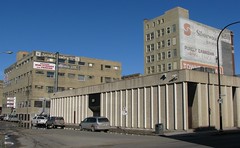
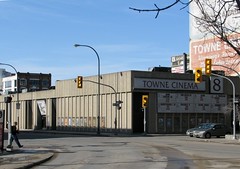
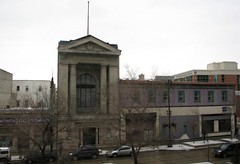
Towne Cinema 8
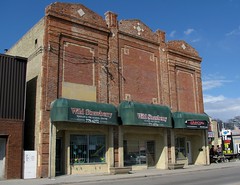
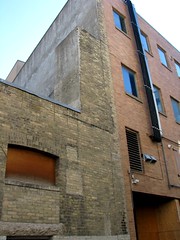
Bottom photo, far left, is City Dairy's stable building today

City Dairy was established in the late 1880s and was a leader in providing safe, sanitary milk products. It was the first dairy in Winnipeg to sell pasteurized milk and regularly had independent labs inspect their products and facilities above and beyond the standards of the city's health department.

City Dairy built a new plant and offices at the intersection of Adelaide Street and Notre Dame Avenue in 1918 and in 1928 moved their sprawling stables and garage from Maryland Street at Notre Dame to a new, four storey building at 49 Adelaide Street. Another expansion took place in 1937. 

I
n the 1940s, the national Silverwood Dairies purchased City Dairy and renovated the plant. It was eventually rebranded under the Silverwood name.

In 1974, Silverwood relocated its dairy operations to the suburbs and the downtown building were put up for sale. The dairy plant was torn down in June 1980 but the stable building still exists today.
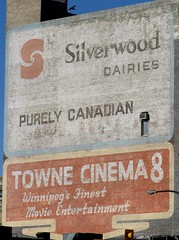

3ex150

Landmark Cinemas bought the empty property and in 1981 built Canada's first stand-alone multiplex, (to this point they were always attached to malls or other attractions.)

Reg Nalezyty of the
Thunder Bay architectural firm DCSC Limited was the principal architectural designer, structural engineer and project construction manager. His design called for the use of load bearing pre-cast concrete panels which made for quick construction. Work began in early March 1981 and the building was opened on August 21.

Unlike the other downtown large multiplex under construction, Cineplex's Eaton Place Cinema 7 which had only an average of 80 seats per screen, the Towne's capacity ranged from 125 to 450 seats per screen.

Another unique feature of the 30,000 square foot Towne was its bi-level, 7,000 square foot lobby that allowed hundreds of movie-goers to wait inside for their film to begin. It was a feature that their stand-alone competitors could not offer.

August 15, 1981, Winnipeg Free Press

The Towne Cinema 8 opened on August 21, 1981 with the following films on offer at its eight screens: Breaker Morant, Paul McCartney and Wings' Rockshow, a re-release of Blazing Saddles, This is Elvis, The Four Seasons, Italian film Così come sei, Lunch Wagon and Just a Gigolo.


Also in 1981, it hosted the world premiere of the film Tulips, brought Apocalypse Now back to Winnipeg so that it could be shown for the first time in 70 mm with Dolby Sound. In early 1982, it hosted the world premiere of If You Could See What I Hear and began showing Arthur, which it held over for more than a year.


As with its earlier Winnipeg incarnation, the Towne did not shy away from controversial titles.

In December 1981, it screened the National Film Board's Not a Love Story: A Film About Pornography. The following month came Caligula, which played here without the protests and obscenity charges that it faced in Alberta. (A 1980 Edmonton showing of Dracula Sucks brought an obscenity conviction that led Landmark on a five-year court battle that ended with the Supreme Court of Canada overturning the lower court's decision.)


July 20, 1982, Winnipeg Free Press

The Towne was the first cinema in the city to introduce discounted weekday admission prices in 1982. Most films were only $2.00 Tuesdays to Thursdays instead of the usual $4.25. They also offered parking discounts in nearby lots and a small arcade area to pass the time while waiting for your film to start.


Within a few years of the Towne's opening, downtown's first-run cinema market was taking a hit from new suburban mall multiplexes. As a result, the Metropolitan closed in 1987, the Capitol in 1990, the Odeon/Walker in 1990, and Eaton Place Cinema 7 in 1991.

The same pressures put a temporary end to the Towne Cinema 8's days as a first-run theatre. Attendance was dropping and Landmark was not interested in running a discount or second-run cinema. In the early 1990s they leased the building to Cineplex Odeon but the deal was not renewed in 1995.

Cineplex Odeon walked and Landmark closed the Towne Cinema 8 on February 26, 1995.

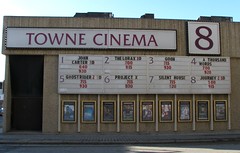
Towne Cinema 8


Landmark reopened the Towne Cinema 8 a few weeks later in April 1995 with the two largest screens showing first-run films and the rest showing second-run and special features. Eventually, most screens showed first-run movies.

It also kept its policy of discount pricing with films only $5.00 as of October 2021.

No Time to Die at Towne Cinema 8 on October 16, 2021

Like all Manitoba cinemas, the Towne Cinema 8 closed in March 2020 after Manitoba declared a state of emergency and wide-ranging restrictions on public gatherings. It reopened along with other Manitoba cinemas in July 2021 at 50 per-cent capacity and requiring proof of vaccination.

Post-pandemic staff shortages at Landmark's Grant Park Cinemas led the chain to temporarily close the Towne on July 7, 2022 so that staff could be redeployed.

That closure became permanent when the building was put up for sale in January 2023. According to the Free Press story, there is a "no cinema" clause that goes with the purchase ensuring that the building will most likely be torn down. (The official boundaries of the Exchange District National Historic Site exclude the Towne Cinema 8 property.)

The Towne Cinema 8 was the last commercial cinema in Winnipeg. The only others to last into the 2000s were the Northstar Cinemas, which were closed by Famous Players in 1996 but reopened from 2000 - 2001, and the former Portage Place Cinemas which became the Globe Cinema when Landmark Cinemas took them over in 2002, that closed in 2014.

For more about the rise and fall of Winnipeg's downtown cinemas, see my West End Dumplings post "And then there were none".
Thursday, March 1, 2012

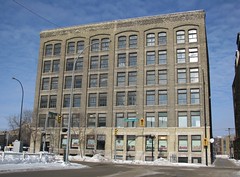
315 Portage Avenue - Kennedy / Mitchell Copp Building

To be demolished Spring 2012. See Centrepoint Development
Kennedy / Mitchell Copp Building

Place:
Kennedy Building / Mitchell Copp Building
Location: 315 Portage Avenue

Opened: 1906 & 1919
Architect:
J. D. Atchinson
Contractor:
William Grace Company


December 6, 1906, Winnipeg Free Press

The Kennedy Building was constructed in 1906 for local businessman Charles William Nassau Kennedy. Originally numbered 315 - 321 Portage, it was 88 feet wide and three storeys in height, (another three could be added but never were.)

A carpenters' strike delayed the interior construction but when it did begin to open in March 1907, Kennedy had no trouble filling the space. Located right across from the new Eaton's store, that block of Portage had become one of the most sought after retail locations in the city.


An assortment of 1907 newspaper ads

Above is an assortment of 1907 newspaper ads of Kennedy Block tenants. They also included Bishop Realty (relocating from the from Hamilton Building), Wm Fingland, Architect and Engineer (relocating from 490 Main). Owner Kennedy and his partners A.W. Daly and Charles Vokes also had offices. They were agents for a number of financial and insurance companies and ran City Financial Corporation.


February 3, 1920, Winnipeg Free Press

In 1918 the Red Cross opened an office to fund raise and organize the delivery of goods for returned soldiers and their families. It quickly had to turn its attention serving those who had fallen ill from Spanish Influenza.


July 1, 1919, Winnipeg Free Press

In the 19-teens Kennedy divided the property. The 34 feet to the east was sold off to the Bank of Commerce. The western portion of the building was sold in 1920 to long-time tenant John Affleck, owner of tenant Yale Shoe Stores. Affleck paid $5,000 a foot which was a record for Portage Avenue real estate. (The west portion of the building was eventually renamed the Affleck Building.)

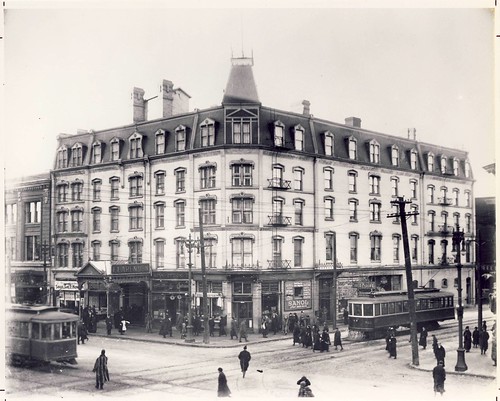
Clarendon Hotel, Winnipeg, c. 1950
Left to right: the Kennedy / Affleck Building, Mitchell Copp Building and Clarendon Hotel (source)

In 1919 the Bank of Commerce announced that they would begin construction on their portion of the building, now addressed 315 Portage. Carter Halls Aldinger received the $100,000 contract to remove the facade and reconstruct the office area and install a glass roof.

Mitchell Copp Building
The facade was replaced with limestone and featured two large columns to mimic the bank's headquarters on Main Street, (now the Millennium Centre.)

Mitchell Copp Building Mitchell Copp Building

The bank took up two of the retail spaces on the main floor while Liggett's Drug Store remained as the other tenant until 1927. At that point, Ligget's was gone and Fraser and MacDonald were hired to reconstruct the main floor as a single space for the bank and reduce the number of public entrances on the front to one.


Time Building fire ca. 1954 (source)

In 1954 the devastating Time Building fire destroyed three building and damaged many more, including 315 Portage. The rear windows were broken and the heat caused the skylight to cave in. In the photo above you can just make out top of the building.

Mitchell Copp Building

Another close call came in 1973 when the remaining portion of the old Kennedy Building, (by then called the Affleck Block), was severely damaged by fire. Neighbouring buildings were damaged by smoke and water. (It is sometimes written that 315 Portage's top floors were destroyed by fire but that is not the case, just the Affleck portion.)


October 7, 1969, Winnipeg Free Press

In 1958 the bank relocated to a new building on the former Time Building site. For a short time the Winnipeg Real Estate board occupied the building then in September 1969 Mitchell Copp, a well known local jeweller, opened there.

In 1981 Mitchell Copp relocated and the building sat vacant, with the exception of a short stint as home to Comic World. In 1992 a fire in the building destroyed the roof and top two storeys. It has been vacant ever since.

Source: CentreVenture

In summer 2011 Longboat Development announced a new mixed use development for Donald and Portage. Four buildings, including 315 Portage, are slated for demolition, though the intention is to incorporate the facade into the new development.

A little piece of 315 Portage through the years:

Clarendon Hotel, Winnipeg, c. 1950
Former Clarendon Hotel

Related:
My photo album of the Donalda Building
315 Portage Ave Historic Buildings Committee
Mitchell Copp Building Photo Album