© 2022 Christian Cassidy. Updated 2025.

Place: Roxy Theatre, Roxy Lanes
Address: 385 Henderson Highway (Map)
Architect: Max Zev Blankstein
Opened: December 24, 1929
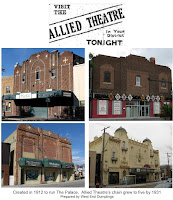
The roots of the Roxy Theatre date back to Jack Miles and his Palace Theatre on Selkirk Avenue, which opened in 1912. He soon went into partnership with Nathan Rothstein to create Allied Theatres and by the end of the 1920s, they added The Roxy (on Henderson), The Rose (on Sargent), and The Plaza (on Marion). The Uptown (on Academy) was added in 1931 to make it a chain of five.
Miles' go-to architect for his theatres was Max Zev Blankstein (also see), who designed over a dozen theatres in Manitoba and Saskatchewan throughout his career. (Including the Tivoli on Maryland and likely the Garry in Selkirk.)

December 21, 1929, Winnipeg Tribune
The Roxy was built in 1929 as a "moving picture house".
Curiously, its construction was supervised by Mr. Battershill of the East Kildonan engineering department. This would have been too early for it to be a civic Depression Relief project, but perhaps it was an amenity that the Municipality of East Kildonan wanted so badly for its residents that they offered up Battershill's labour to sweeten the pot.
An advertorial in the Winnipeg Tribune of December 21st noted that the Roxy could hold 1,200 people, boasted a $22,000 sound system, and had the latest Simplex brand projectors.
The Roxy was an "atmospheric theatre".
This is a style that became popular in the U.S. in the late 1920s, where the theatre's interior was designed to give patrons the impression that they were sitting outside under the stars watching the film. It was done by implanting "stars" in the ceiling and projecting clouds onto it. In the case of the Roxy, "the walls are exteriors of quaint Spanish houses with sloping tile roofs, windows daintily curtained and lightened."
Blankstein would take his experimentation at the Roxy to the next level when he designed the Uptown and its "Moorish courtyard" the following year.

January 4, 1930, Winnipeg Free Press
The Roxy Theatre opened on Christmas Even 1929 with a showing of "Why Leave Home" starring Sue Carol and Nick Stuart.
Starting the first week of January, the Roxy began advertising free parking with heater plugs-ins in the lot adjoining the building. A uniformed attendant was on-hand to assist drivers.

January 22, 1949, Winnipeg Tribune
Neighbourhood theatres had to be flexible to survive. Many, even those built as movie houses, had a small stage at the front so that it could be rented for other uses. The Roxy hosted countless singing recitals, public speeches, church services, and other community events throughout its life.
The 1950s were tough on neighbourhood theatres as television was establishing itself as the public's entertainment media of choice. Some small chains folded or merged with each other to try to weather the storm.
The Roxy became part of the Associated Theatres chain, still controlled by the Miles Family, and with its collection of sister neighbourhood theatres participated in weekly promotions like Foto-Nite and was a bingo hall on Thursdays.

May 20, 1960, Winnipeg Tribune
The final films shown at the Roxy are likely noted in the above ad for May 21, 1929. Disney's Sleeping Beauty was the matinee with Wild Heritage starring Will Rogers as the evening fare.
Starting May 27, classified ads appeared in the Free Press that stated simply: "Wrecking Roxy Theatre, free firewood, EK."
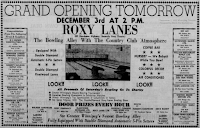
December 2, 1960, Winnipeg Tribune
The Roxy Theatre reopened as the 5-pin, 20-lane Roxy Lanes on December 3, 1960 under manager Roy Keena, a retired City of Winnipeg health inspector. Alderman Stan Batterhill cut the ribbon. The first day consisted of various media outlets playing each other in a tournament. The proceeds went to the Press-Radio Scholarship Fund for Orphans.
It was a golden era for Winnipeg bowlers as the Roxy, Uptown Lanes (in the refurbished Uptown Theatre), and Windsor Lanes all opened within a few months of each other.

It is unclear who owned the Roxy when it opened. It was simply Roxy Lanes Ltd. with Keena as manager. He served in that position until at least 1964.
In 1970, Marcel and Ella van Styvendale bought Roxy Lanes. Ella died in 2001, and her husband continued to operate it until he died in 2008.
In 2009, Robert and Melissa Gauthier purchased Roxy Lanes. Robert had previously been running the Marion Hotel and was looking for a change.
The couple managed to keep the business afloat through the COVID-19 shutdown and celebrated its 60th anniversary as a bowling lane.
Robert died on February 10, 2022, and on April 13, 2022, Roxy Lanes announced on its Facebook page that: "...we have made the decision to sell our property. April 30, 2022 will be the last day for bowling. I would like to thank the great community of Elmwood and surrounding areas for all the support throughout these years."

Roxy Lanes in 2011
There was an unsuccessful attempt in the summer of 2022 to obtain a historical designation for the building that would prevent its demolition.
The purchaser of the building was the Manitoba Metis Federation. It announced in 2024 that it was ready to proceed with the construction of a 50 to 60-unit, 55+ affordable housing facility based on one that it recently opened in Selkirk, Manitoba.
Demolition began in November 2025.
Related:
Roxy Lanes could face wrecking ball CBC Manitoba, Apr. 2022
MMF plans to raze bowling alley for seniors housing, Aug. 2024
Winnipeg's Roxy Lanes bing demolished CTV Winnipeg, Nov. 2025
Roxy Theatre / Roxy Lanes Historic Buildings Report 2023 (with interior photos)


So incredibly sad if this relic were to be destroyed
ReplyDeletevery sad - hope this building is not 10 stories high
ReplyDeleteIt is unfortunate the MMF did not try to incorporate the exterior brickwork into the design of their new building. Red River College did on their Princess Street campus. You can see how nice the brick is on the second level. The main level was covered over with 1960 style finishing.
ReplyDelete