Showing posts with label Smith Street. Show all posts

Tuesday, May 4, 2010

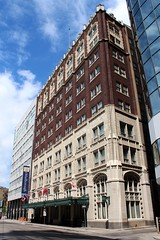
364 Smith Street - The Walker Theatre

© 2010, Christian Cassidy
Place: The Walker Theatre / Odeon Cinema / (Burton Cummings Theatre)
Address:
364 Smith Street (Map)

Opened: December 17, 1906 (official opening Feb 18 1907)
Architect:
Howard C. Stone

Contractor: Canadian White Co. (Montreal)

Background
:


Corliss Powers Walker and his wife Harriet Anderson Walker owned a small chain of theatres in the U.S. Midwest. They worked as a team with him responsible for the business dealings while she handled the bookings and promotions.

They moved to Winnipeg in 1897 and leased the Bijou Theatre, renaming it the Winnipeg Theatre. Their goal was to one day have a custom-built theatre here that would be the centrepiece of their chain.

Elevations: Ellice Av. above, Smith St. 

Finally, in 1905, they hired Montreal architect Howard Colton Stone to draw up plans for a theatre, inspired by Chicago's Auditorium Theatre, along with a hotel complex that would be added at a later date. This explains why the building's facade is largely of plain brick with the exception of a small stone facade around the entrance. (In the Smith Street elevation above I have placed the existing facade beneath where it was to fit into the master plan.) 

I cannot find references as to why the hotel was never constructed. I imagine, though, that the difficulties encountered by the nearby independent Olympia / Marlborough Hotel would have kept the Walkers out of the railway-dominated high-end hotel business.

Genser's Furniture
ca. 1907 (source)

The Walkers went to great lengths to be able to claim that the building was "completely fireproof", a good selling feature in an era of disastrous theatre fires around North America. (In fact, the Walkers' former Winnipeg Theatre burned in 1926 killing four firemen and injuring 11 others.)

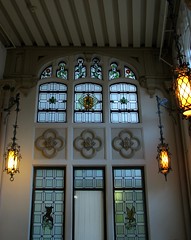
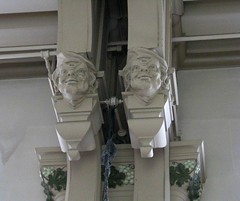
The Theatre features a steel frame construction with concrete exteriors walls and floors throughout, even for the balconies and beneath the stage. The interior walls are clad in terra cotta.

T
here were more entrances than required by the era's fire code and it was said that the hall could be vacated in less than three minutes. A forced air system ensured not only comfort for patrons but allowed for the quick removal of smoke should fire ever strike.


December 13, 1906, Winnipeg Tribune

Construction was delayed for several weeks due to a series of city-wide builders' strikes in 1906. Their first booking, however, had already been made: the Australian youth musical troupe Pollard's Lilliputian Opera Company. They had no choice but to open the theatre on December 17, 1906 and Pollard's headlined for three weeks. 

Construction continued around show schedules for several weeks. The formal opening took place on February 18, 1907 with a production of Madame Butterfly.

http://www.virtual.heritagewinnipeg.com/vignettes/window/thenNow/129then.htm

The Walkers worked hard to live up to their billing as Canada's Finest Theatre by booking A-list acts from around the world.

The Walker saw the likes of Clara Butt, Maude Adams, Adelina Patti, Viola Allen, Margaret Anglin, Edythe Chapman, May Robson,
Florence Easton, George Arliss, Johnstone Forbes-Robertson, Robert Mantell, Dustin Farnum, Conway Tearle and Lillian Russell. (Note, not Charlie Chaplin!)

Sadly, the Walker Theatre was home to the final performance of British acting couple Laurence Irving and Mabel Hackney.

After a series of successful dramas staged in May 1914 they left ahead of their crew to take the Empress of Ireland back to England. The ship sank en route, killing more than 1,000 people, including Irving and Hackney.


It also hosted a number of significant local political events.

On January 28, 1914
, it was the scene of the Political Equity League's Mock Parliament co-organized by led by Nellie McClung, a good friend of Harriet Walker's. On December 22, 1918 it hosted one of the largest pre-general strike meetings chaired by John Queen that passed several "radical" resolutions.

Live theatre began to struggle in the 1920s as 'moving pictures' became the favoured form of entertainment. Talkies and The Depression dealt the final blows for the Walker. It was seized by the city in 1936 for back taxes of about $35,000.

For the Walkers, it was a crushing loss. They would never see the theatre open again as C.P. Walker died in 1942 at the age of 89 and Harriet died the following year.

August 1, 1944, Winnipeg Tribune 

The city leased the theatre short-term to local promoters and it hosted numerous political speeches, concerts, and school recitals. The city lost money on these leases and in 1944 decided that the time was right to put the venue up for sale. 

Just two offers came in, both for around $35,000, which caused splits on city council. Some wanted to hold out for more money, some wanted assurances that the theatre would not be bulldozed, and others felt that the city just needed to be rid of the "white elephant" regardless of price or outcome.

The purchase deadline was extended for another week to see if better offers would come, but none did.


November 2, 1945, Winnipeg Tribune

One of the offers was from Henry A. Morton, manager of the nearby Odeon Garrick, a theatre of the same vintage that had been retrofitted into a cinema. He had similar plans for the Walker. 

To sweeten his bid, Morton added a last-minute guarantee that the Walker would remain a theatre for a period of ten years, even if he ended up selling it or leasing it to another party. Council voted 10 to 7 in favour of his bid.

The Walker underwent a number of renovations to convert it into a cinema. The seats were replaced, a dropped ceiling was installed, the lobby was modernized and a screen and sound system added. It reopened on November 3, 1945 as the Odeon Cinema with the James Cagney film Blood on the Sun.

The Walker continued on until March 29, 1990 when Cineplex Odeon closed it and put it up for sale.

Katz ca. 1990

Two groups vied for the building in 1990.

One was the Manitoba Choral Society and the other was a non-profit group headed by Nite-Out Entertainment's Sam Katz and Bruce Rathbone, (now known as the
Walker Theatre Performing Arts Group Inc.) The latter won out and purchased the building on October 1, 1990 for $700,000, which included a $250,000 grant from the Core Area Initiative.

Walker Theatre

The group began a multi-year restoration project to undo what Odeon did decades earlier. Fortunately, the hidden treasures were left mostly intact.

The stage behind the giant screen was an empty void, the stunning terra cotta and plaster was in place though damaged by the installation of the dropped ceiling and other modernities, and even the third balcony, nicknamed the "Gods", was found under the false ceiling.

The Walker reopened on March 1, 1991, in the midst of renovations, with a concert by Blue Rodeo.

In August 2002 The Walker was renamed for Winnipegger and Guess Who front man Burton Cummings in exchange for playing some benefit concerts to help retire the theatre's then $1.8m debt.


In 2007, the Walker Theatre was named a National Historic Site.

Downtown Winnipeg
UPDATE 2014:  

The theatre struggled as a stand-alone, live venue. In April 2014 True North Entertainment, owner of the Winnipeg Jets and MTS Centre arena, announced that they had reached a long-term lease agreement with the Walker Theatre Performing Arts Group Inc..They will now be responsible for the bookings and its management.

Related:
Burton Cummings Theatre website
Walker Theatre Vignette Heritage Winnipeg
Walker Theatre Winnipeg Building Index
364 Smith Street Historic Buildings Committee Report

My Flickr album of the Walker Theatre
Finest playhouse in the Dominion Cherney Pt 2
Agenda Paper: The Walker Theatre Parks Canada
History and Chronology Burton Cummings Theatre

Also see:
On Stage: Theatre and Theatres in Early Winnipeg MHS
There is also a book called 'Curtain Time' by Ruth Harvey, daughter of the Walkers, published in 1949. Excerpts appeared in the Winnipeg Tribune that year.

Saturday, April 17, 2010

Odeon / Walker Theatre Mural

Walker
Title: Untitled
Address:
364 Smith Street (south side) Map
Unveiled: 1972

Artist:
Winston Leathers

Background


Artwalls was a national art program in the 1970s sponsored by
Benson and Hedges Tobacco Company to 'enhance the urban environment' by painting murals in high traffic areas of Canada's main cities. In the summer of 1972 they teamed up with the Winnipeg Art Gallery to choose three finalists for Winnipeg's downtown: Bill Lobchuk, Bruce Head and Winston Leathers.

This was Leathers' creation. Unfortunately, I cannot find information about the locations of the other two murals.

Related:
364 Smith Street
The Murals of Winnipeg

Tuesday, February 9, 2010

Downtown Places - The Marlborough Hotel

Updated November 11, 2014

Marlborough Hotel, WInnipeg
Place: The Marlborough Hotel 
Address: 331 Smith Street (Map) 
Opened: November 18, 1914
Architect:
James Chisholm (1913); J. H. G. Russell (1923 expansion)

Contractors: Carter-Halls-Aldinger (1913 and 1923)

Background:
Olympia Café, main floor (source)

The roots of today's Marlborough Hotel go back to four Italian businessmen and a little restaurant on Portage Avenue.

Giuseppe (Joseph) Panaro and Leonardi Emma came to Winnipeg from Sicily in 1892 and operated a fruit and confectionery store on Main Street, on the present-day site of the Canadian Wheat Board Building. In 1900, the business expanded to include a restaurant.

Brothers Augustine and Joseph Badali operated a fruit and confectionery store at the corner of Portage Avenue and Smith Street. When their premises were demolished in 1905 to make way for the first Kensington Building, they reopened on the main floor of the new building.

The expanded shop included a restaurant called the Olympia Cafe and attracted new business partners in Panaro and Emma.


November 14, 1914, Winnipeg Tribune

A piece of land opened up on Smith Street behind the Kensington Building in 1912 after a blacksmith's yard burned to the ground. The four men purchased it along with some neighbouring lots and announced plans to build a four-storey luxury hotel called the Olympia.

They hired prominent architect James Chisolm and Son, who: “...refused to be influenced by the present-day tendency to use with abandon the over-decorated and superficial styles of the French period and have followed, instead, the quiet, beautiful Gothic school of Medieval England, with just sufficient of the renaissance added to give the air of elegance and luxury common to metropolitan hotel life.”

November 14, 1914, Winnipeg Tribune

Constructed by Carter-Halls-Aldinger, the facade of the four storey structure, aside from the simple granite base, is of terra cotta.

The cast iron and glass marquee features five Gothic lamps weighing one ton each and was manufactured in Elmwood by Western Steel and Iron Works.

In the back lane off Smith Street, there is a cornerstone containing the architect's name in a gothic script.

Marlborough Hotel

The Gothic design carries through to the interior.

The main floor features marble pillars and floors with Caen stone walls and oak paneling. Another feature is the elegant stained glass windows, three of which feature fairy tale characters such as Cinderella and the prince from Beauty and the Beast. Other features include large hanging lamps by Tiffany and Co. of New York.


The main floor and mezzanine housed the administrative offices of the hotel, including the telegraph room and switchboard. It was also home to the main lounge, a ladies’ reception room, dining room and bar. Retail services included private phone booths, a barber shop, and a news and cigar stand. There was a more informal grill room in the basement accessible via a marble staircase.


The investors did not take a chance on the management of such a fine hotel. They hired A. T. Folger, who had been the manager of Ottawa's Chateau Laurier since it opened in 1912. Folger, a "charming" native of North Carolina, and his wife arrived in the city just days before the Olympia's grand opening at  2:00 p.m. on November 18, 1914. 

The timing could not have been worse. When first envisioned in 1912, Winnipeg was enjoying the most prosperous year in its history. Money and luxury were no object, as reflected in the hotel's reported $900,000 price tag. Compare that to the $1.5 million that the Hotel Fort Garry cost just two years earlier, which was funded by a deep-pocketed national railway.

The following year, Winnipeg fell into a recession, which deepened at the start of the First World War. The war also shrank the market for luxury travel and extravagant events. The city's other top hotels, the Fort Garry and Royal Alexandra, both owned by railways, could at least funnel their steady stream of train and ship passengers into them at lower rates to fill rooms. For a stand-alone venue such as the Olympia, that option didn't exist.

May 28, 1915, Winnipeg Tribune

Newspapers did not often report on the ongoing bad news of large advertisers. The first cracks, though, appeared in an April 1915 Free Press report that Folger had tendered his resignation back in February. He refused to discuss the reasons why, but confirmed that he would stay on until the end of April so that a successor could be appointed.

It turns out that a successor would not be needed. In a single paragraph story in the Free Press on May 5, 1915, it was reported that creditors had stepped in the week before and tried to attract additional investors or new buyers. There were none to be found, so it was agreed that the hotel would cease operations immediately. (A news story five years later noted that only one payment had ever been made on the building's $350,000 mortgage.)

The creditors tried to salvage what they could by selling off the building's furnishings at pennies on the dollar. A sign of how bad things likely were for the hotel: some of the bedroom suites were advertised as "never been used".

Top: Troops outside Olympia Hotel ca. 1915 (source)
Bottom: March 2 1916, Winnipeg Tribune

The war may have been the final nail in the coffin for the Olympia, but it was also its salvation for the creditor (the Great West Securities Co.). The federal government was desperately seeking space to house soldiers who came to Winnipeg from across the region. The Olympia, with its large rooms, dining facilities, meeting space and its close proximity to both train stations, was a perfect fit.

It was announced in Feburuay 1916 that the federal government had leased the hotel as the new recruiting centre and barracks for the 184th Battalion. It took just a week to outfit it with army-issue bunks and furniture. The former luxury hotel was featured prominently in some of the 184th's recruiting ads, noting that it had the "finest barracks in Canada".

Many young, single soldiers gave up their apartments when they enlisted. As a result, dozens of war dead list "The Olympia Hotel" as their final address.

Top: February 19, 1919, Winnipeg Tribune
Bottom: February 23, 1919, Winnipeg Tribune

The government vacated the building in 1918, and the following year it was leased to local hotelier John Lee for about $10,000. Lee had a long history of owning and managing hotels in the city, including the National and the St. Regis.

Soon after taking over, other services such as the restaurant and barber shop were reopened and the hotel was back in full swing.

Top: December 23, 1919, Winnipeg Tribune
Bottom: December 30, 1919, Winnipeg Tribune

Lee remained at the Olympia until December 1919, when Thomas Babin took over for a period of a few months. Babin pushed the food and entertainment side of the business by introducing after-theatre suppers and dances, masquerade balls, Sunday afternoon concerts, and daily meal specials in all of their restaurants.

The Olympia soon became the venue for many of the city's largest conferences and banquets.


Things went so well that in March 1920, architect J H G Russel was hired to draw up a five-storey addition to the hotel (a further sign of how bullish the original owners were, the building was constructed with such an expansion in mind.) Carter-Halls-Aldinger returned as the contractor.

July 9, 1921, Winnipeg Tribune

It was originally thought that the hotel could remain open during the $600,000 expansion, but soon after the work got underway in the spring of 1921, it became apparent that it would have to close as new elevators and mechanical areas had to be added to the original structure. The hotel closed on June 15, 1921.

Seventy men worked on the reinforced concrete addition, which is clad in Fort William corduroy red brick with Bedford stone trim. The main feature of the addition was the eighth floor 50 x 52-foot banquet room (called Marlborough Hall) with its own kitchen and an adjoining 50 x 40-foot concert room called the Blue Room. The two spaces could be opened into each other for large events.

http://www.mhs.mb.ca/docs/people/webb_rh.shtml
Ralph H. Webb (source)

While construction was underway, Col. Ralph Webb, manager of the Windsor Hotel in Montreal, was hired on to run the expanded business.

Webb had previously lived in Winnipeg from 1906 until he left to serve in the war. It was a fortunate hire for not only the hotel, but the city. Webb became a huge Winnipeg booster and, just two years later, became its mayor.


Besides a new manager, the hotel would reopen with a new name: The Marlborough.

July 10, 1923, Winnipeg Free Press

The Marlborough was to open in November 1922, but construction fell behind schedule.

It had a "soft opening" on May 3, 1923, when it hosted the University of Manitoba Student Union's end of year dance in the new ballroom, but it did not formally open until July 10, 1923.


The new hotel boasted 230 bedrooms, each with its own bath. One planned feature that never got constructed was a rooftop garden restaurant.


As soon as it opened, The Marlborough became one of Winnipeg's premiere hotels for conferences, banquets, concerts and other special events. The dream that Panaro, Emma and the Badali brothers had in 1912 had finally come true.

It appears that Great West Securities Co. sold the building the year after the expansion. Whether that was to finally recoup its money after 20 lean years, or due to the financial stress of the delayed opening, is not clear.

Several organisations of note had a connection to the hotel. In 1925, it was the site of the conference that created the Royal Canadian Legion. A number of local organizations, from the Winnipeg Board of Trade to the Winnipeg Press Club had their headquarters there.


Bottom: April 5, 1957, Winnipeg Free Press

Through the 1950s, the hotel industry began to change. Old world charm was giving way to "motor hotels" with their easy-access parking and rooms that featured modern amenities like air conditioning and full bathrooms. The Marlborough decided that it would give customers the best of both worlds.

In 1956, Libling Michener and Associates was hired to design a $1.85 million dollar expansion. the first phase was a new, self-serve parkade that opened right across the street in April 1957. At the same time, work got underway on an eight-storey addition to the north of the old hotel.

Marlborough Hotel postcard ca 1960s

The new wing opened on February 4, 1960.

It introduced the Skyview Ballroom, which, combined with the adjoining Marlborough Hall, made the hotel the largest conference centre between Toronto and Vancouver. At the gala opening, Winnipeg ex-pat and Canadian singing icon Juliette performed.


With the "new" hotel, came new management. David Rothstein was appointed president and general manager of the ownership group while Kenneth Belyea, former general manager of the Ritz Towers in New York City, became the manager.

The ballroom combined with venues such as Churchill's Dining Room made the Marlborough one of the places to be seen in Winnipeg. 

Marlborough Hotel

Competition from motor hotels and the shrinking train travel market had devastating effects on old-school, higher-end downtown hotels.

After years of decline and lack of investment, the CPR's Royal Alexandra Hotel on Higgins Avenue was demolished in 1971. In 1979, CN sold the Hotel Fort Garry to independent owners needing millions of dollars in upgrades. The Marlborough saw a similar decline.

The German Canadian Congress purchased the hotel in 1990 for a rumoured $5.5 million with the intention of turning it into a seniors home. When government funding fell through, the hotel closed briefly in August 1992 before reverting to its previous owners.

The hotel underwent renovations and by 1995 was operating under the Ramada Hotel banner as the Ramada Marlborough Hotel.  


In September 2001, the hotel was purchased for $4.1 million by a new ownership group that wanted to invest millions to renovate the building and convert former office and conference space on the top two floors of the old wing to guest rooms. They applied for a Heritage Tax Credit in 2004.

One significant investment by the new owners was the purchase of the closed Garrick Cinema to the east of the hotel, which it converted into a conference centre and one of the cinema spaces into a waterslide and swimming pool for the hotel. The main floor Regal Beagle bar replaced a series of short-lived nightclubs in 2002.

UPDATE: 

By the 2010s, the hotel had fallen on hard times and was taking in medical stay clients as much as regular hotel visitors. It received horrible hotel reviews and was making the news for all the wrong reasons, such as failing fire inspections, boiler failures, fires, and murder. 

The final straw came in late 2023 when a woman allegedly tried to stab a member of the hotel staff with a knife and was restrained by security until police came. Video of her being held made the rounds on social media, which led to protests outside and inside the hotel in January 2024. After one of the protests the hotel closed temporarily due to threats to staff and management of the hotel and it never reopened. 

In March 2026, the mayor announced in a speech that there was a proposal to turn the Marlborough Hotel into a 307-unit housing block, with 40 of them affordable rent units. The hotel had used about 150 rooms, mostly in the newer wing, so this would mean a renovation of space in the old wing and perhaps conversion of some conference and other space into rooms.

Related:
My photo album of the Marlborough Hotel
331 Smith Street Winnipeg's Historic Buildings Committee
Marlborough Hotel Winnipeg Architecture Foundation
Our History The Marlborough Hotel